Wednesday, July 28, 2010

Hiking to the elusive Guvano Beach


By: Christen Calloway

Secluded, quiet, and adults only, the magical cove I am determined to find. Guvano Beach is the only “clothing optional” beach in Cinque Terre, which means “five lands.” The villages that make up the lands are, from south to north, Riomaggiore, Manarola, Corniglia, Vernazza and Monterosso.

A UNESCO World Heritage Site, Cinque Terre has been restored and preserved in large part because of fees hikers pay to walk the often steep and rugged pathways that connect the five villages. Although not entirely car-free, the area is remarkably clean and unspoiled. You can reach Cinque Terre by train from any major city with several trains per day and it is also possible to drive to the five lands, though parking is sparse.
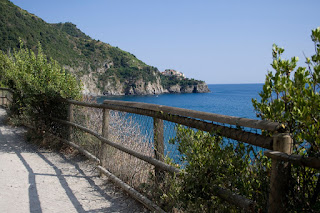
With the sun glaring, we walk the least challenging flat coastal path toward Corniglia for 45 minutes, and stumble upon hand-carved maps showing us stairs and the tunnel to Guvano. We pound up the stairs past where the path is closed for repairs and continue north to the foot of the steps to Corniglia, a dead end. Confused as to where the path continues, we find stairs leading to a small house and a gate leading to beaches below. A woman and her daughter appear with a key to the gate and I yell “Mi Scusi!” In broken Italian, I ask where Guvano Beach is. She smiles and says, “Oh! Guvano!” and she gestures to go around the corner of the house. I interpret her next movements as button pushing, and she says “Light? Bzzz.”
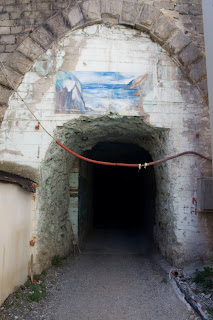
We round the corner to find a tunnel with painted scenes of nude figures on a beach, “Guvano Beach one kilometer through tunnel” one sign says. In mouth of the pitch-black tunnel there is an intercom with the words “Push here for lights,” so we push. And we push. And nothing happens. Our group of four young women begins to have second thoughts about the black abyss before us. Tech-savvy students, we pull out cell phones, no good. Cameras, better, but not enough.

One of my companions wants to turn back, but I offer to lead the way with the LCD screen on the back of my large camera. We stay to the left and walk slowly on the sidewalk of the cavernous tunnel. Every step, incline, and slippery spot we shout “STEP!” to warn the girl behind us so she doesn’t trip.

The tunnel takes a curve and we are suddenly in a darkness I had never experienced. We imagine what kinds of creatures lurk in the blackness. I block the terrifying thoughts of bats and focus on the ground before me: it is cool and wet, and the girls wearing flip-flops call it muddy and slimy.

We hear a loud noise coming towards us, like a train or a truck, and I have the sudden urge to bolt. We stare into the abyss like soon-to-be road kill and the train in the tunnel next to us passes.

Timidly, we proceed, rounding a bend where – at last! – we see a tiny light. Our pace quickens. Then we hear footsteps behind us. Muggers? No, just two better-prepared beach-goers with flashlights.
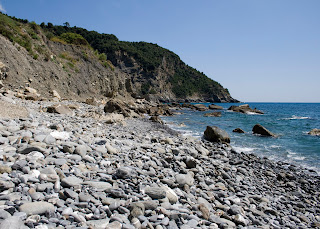
The tunnel opens up to an oasis of trees and a clearly marked gravel path. We pass three men at a table under an umbrella, half expecting to pay them a fee to use the beach, but no one stops us and the beach is free.

One member of the flashlight couple, from Atlanta, asks, “How did you find out about the gay beach?” After I tell him about the guidebooks I read, a naked man with no shoes walks leisurely past, smoking a cigarette. We giggle for a moment about the man’s nudity and get it out of our system.

We look down the rockslide below, “Is that the only way down?” my friends ask. I tell them I have done this before and give tips on how to make it down the scary slope. As we begin our descent, one of the gentlemen from Atlanta offers to help us down. I say I can handle it, but nearly fall all the way down the slope when a rock underfoot gives way and sends me sliding on my butt. But then I gaze on the elusive Guvano Beach, paradise achieved.
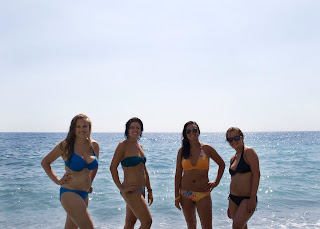
We strip down to our swimsuits and sprint into the turquoise sea. Perfecto! The water is refreshing but not cold. It is our near-private oasis, with only eight other people in sight, each in pairs. We swim out to where the salty sea turns royal blue and yell, “You can see straight to the bottom!” We high-five and congratulate each other on making it through the adventure. We float in the ocean and stare at the green terraced vineyards above and the black cliffs that surrounded us.

Peggy Guggenheim, her legend lives on


By: Ashley McHale
Going on tours of museums in Italy can be very drawn out and detailed, especially at 9 am. Touring the Peggy Guggenheim museum is an experience that can inspire you in to a point you want to know more. At least that’s what I took from it.

Walking into the courtyard and through the glass doors I didn’t know what to expect really. I thought we would see a few great works from Italian artists, most of which I wouldn’t understand but could appreciate. I was wrong. Our tour guide introduced himself and welcomed us to the museum. The museum, which was Peggy Guggenheim’s home, sits on the Grand Canal in Venice.

The incredible wide white home with black rod iron decals was once the collectors living space of luxury and is now full of works of modern art by hundreds of artists including Pablo Picasso, Mark Rothko and Jackson Pollock. Each room is representing a different style, but all of the works are specifically placed and have Peggy’s stamp of approval.

Peggy Guggenheim was encouraged by friends to open a gallery and collect modern art after World War II because of the significance of change in art and the birth of contemporary styles. That she did, and her museum showcases the most notable works of her time. Her more personal rooms, her bedroom and bathroom, hold the works that were closest to her heart.

What was once her bathroom is now dedicated to her daughter Pegeen’s talents. Peggen Vail was the daughter of Peggy Guggenheim and Laurence Vail, a painter and Peggy’s first husband. Pegeen’s early years were spent meeting with some of the most talented artists of the 20th century. At the age of twelve she began painting and her mother was a constant supporter of her work as well as other female artists of the time.

Pegeen’s pieces are very bright and fantasy-like and are of mostly doll like figures in on the canals of Venice. They are fun and joyful which was contradictory to her personal life. Pegeen’s marital problems caused her to have a problem with alcoholism, which took her life at an early age.

The Peggy Guggenheim museum should not be missed when visiting Venice. She was an icon of the city and left it a historical showcase of art from the 20th century. Her lavish ways and passionate personality come out in her home. You get a true sense of her life and may even get a few stories of some of the crazy things she took part in.


Our tour guide took us to the back of her home overlooking the canal and mentioned that it is a legend that Peggy would drink a bottle of prosecco every night and throw the empty bottles in the canal. Our group laughed but I imagined how exciting it would have been to share some prosecco with Peggy and talk about modern art.

Cinque Terre Reverie


By Christen Calloway

Full of German, Italian, and American vacationers and a mix of native Italians, Cinque Terre is an ideal location for outdoor recreation. Whether it’s lounging in the sun, swimming in the calm salty sea, or hiking from town to town through the terraced vineyards and lemon orchards.

Walking through the five small towns of Cinque Terre is a warm, welcoming experience. The coastal villages are filled with locals who actually get to live in such a breathtaking part of the world. The area is, of course, filled with anxious tourists during the summer, but is really made up of people that live their lives on the coast. Going on with their daily routines of working or hanging laundry, it is an easygoing lifestyle they seem to love, judging by their tans and smiling faces.

When hiking the paths of Cinque Terre, the view from above can be a little scary when looking over the edge. Sharp, dark rocks extend down forever, ending in the clear turquoise sea. A tricky balancing act requires staying alert at the steps and curves ahead while also stopping to appreciate the endless horizon, which can be done at almost any point through all 9 kilometers of Cinque Terre hiking paths. Sturdy shoes, not flip flops, are recommended on posters in the towns and in all guidebooks, although many were spotted slipping on path pebbles wearing thin sandals.

While outdoor activities are endless, some parts of Cinque Terre are skimpy on restaurants. The trails themselves are part of a national park, so don't expect any refreshments you don't pack in yourself. Beware of toaster-oven pizzas and microwave pasta seen in Riomaggiore cafes where service lags drastically, as far as servers completely disappearing. The pesto, which is famous in Cinque Terre, is tasty but not outstanding. Stick with the white wine that is made there, which is cheap and deliciously fresh (but be careful you don't get the tres-sweet variety, unless you are having it with dessert.)

Be sure to book hotel rooms in advance during the high season as accommodations are limited and Cinque Terre is a popular vacation spot for Europeans as well as Americans. Much quieter than Rome, Florence, or Venice, plan to relax and unwind at this charming destination.

Mercato Centrale: A Lesson on Cheese

Murano: The Art of Glass Making

Floating into Venice


BY ASHLEY MCHALE

Unlike other cities in Italy, Venice is one of a kind. Most Venetians consider their land a separate entity because of their unique culture and the major bodies of water that pour into the city.


The air is clear and no cars can swerve in the narrow roads. Through the Grand Canal boats roam through numerous waterways.

The waves splashing and the sun reflecting off ancient buildings is the first sight of Venice, and one of the most beautiful.


Most known for its gondolas, Venice's channels are filled with mystery and elegance. It takes exploring through the small pathways to get a true glimpse of its character, while creating a peaceful and relaxing journey to a gorgeous city.


Though a few tourists have discovered the land of brightly painted houses and tiny canals, foreigners are only on the main drag. It is easy to venture into an alley and find empty plazas with laundry hanging on clothing lines in front of pink and turquoise houses.


It is a city that can only be explored by boat or by foot but the imaginative views substantiate the slow pace you will take while and taking the city in.

Siena


Siena is a wondrous city of magical landscape and majestic buildings. Between the vast history of the city and the hundreds of grapes grown here, Siena maintains itself as one of the most beautiful and diverse cities in Tuscany.

Walking through Siena the smells of sangiovese grapes will erode your senses. The winding and hilly roads lead to the main square in which the horse race, Il Pailo, takes place dating back centuries ago.

Standing where Saint Benedict stood many times and gave some of the best speeches known to man, I can see the true origins of Siena. The narrow streets dictate the neighborhoods that separated this great Tuscan city as the Piazza Del Campo unites it.

Venturing outside of the city square, a garden oasis awaits. I step outside to a stone patio, climb the stairs and pass through the garden gates. Passing under trees and past tomato plants leads to a magnificent view of the city and the countryside. I soak in the view, the history and the legacy.